Thursday, August 20, 2015

A Guide to Implement Congestion Charging

Introduction to Congestion Charging: A Guide for Practitioners in Developing Cities  (58 page pdf, Dirk Van Amelsfort and Viktoria Swedish, the Asian Development Bank,  2015)

Today we review a comprehensive guide that describes the various steps necessary to develop and then implement a successful congestion charging system, borrowing on examples of established systems in Stockholm, London and Singapore, among others. Although aimed at developing countries, many of the principles and preparations needed are common to the developed world as well – such as, being prepared with responses to eight objections or concerns often made to any such scheme. The underlying objective has to include elements of fairness of application, as well as environmental and economic benefits with as few exemptions to being charged as possible.


Key Quotes:

“When people drive cars, they contribute to road damage, emit harmful pollutants, noise and vibrations and cause delays for others. Considering this, the travel decision of one individual imposes costs on others. In most transport systems the costs imposed on others are not fully paid for by the traveller. Congestion charging is a way to put such costs on drivers. “

“Arguments are that congestion charging (1) is unfair, (2) harms the privacy of citizens, (3) not achieve the intended effects and (4) will damage the economy. “

“The higher the charge, the lower the public acceptability is, and travellers with a higher value-of-time perception have a higher acceptance of congestion charging …Even if a high value of time may correlate with income levels, these two things are not the same.”

“Factors that affect public acceptance:

“Experience: The more experience …the higher the acceptance.
Dislike of government intervention: ..government should intervene as little as possible..
Interest in environmental issues: ..environmental problems are severe and need to be addressed will favour congestion charging more.
Value of time: The higher the perceived value of time.., the higher the acceptance for congestion charging… the more benefit travelers get in return for the paid charge.
Frequency of car use: The more travellers use their cars, the lower the acceptance level.”

“As soon as congestion charging policies become active - assuming all technologies function and the system is appropriately designed - people will find the system more acceptable. In most cases acceptability rises above a 50%.”

“Recommendations:

·         Focus on impacts
·         Do the homework
·         Use models to forecast effects
·         Prepare to respond to concerns
·         Make revenues generated and how the money is spent transparent
·         Invest in alternative travel options
·         Let the functional design drive the technological solution
·         Reduce political risk by building in redundancies that can later be removed
·         Make sure people understand how to use the system
·         Have a solid legal framework”


Tuesday, August 18, 2015

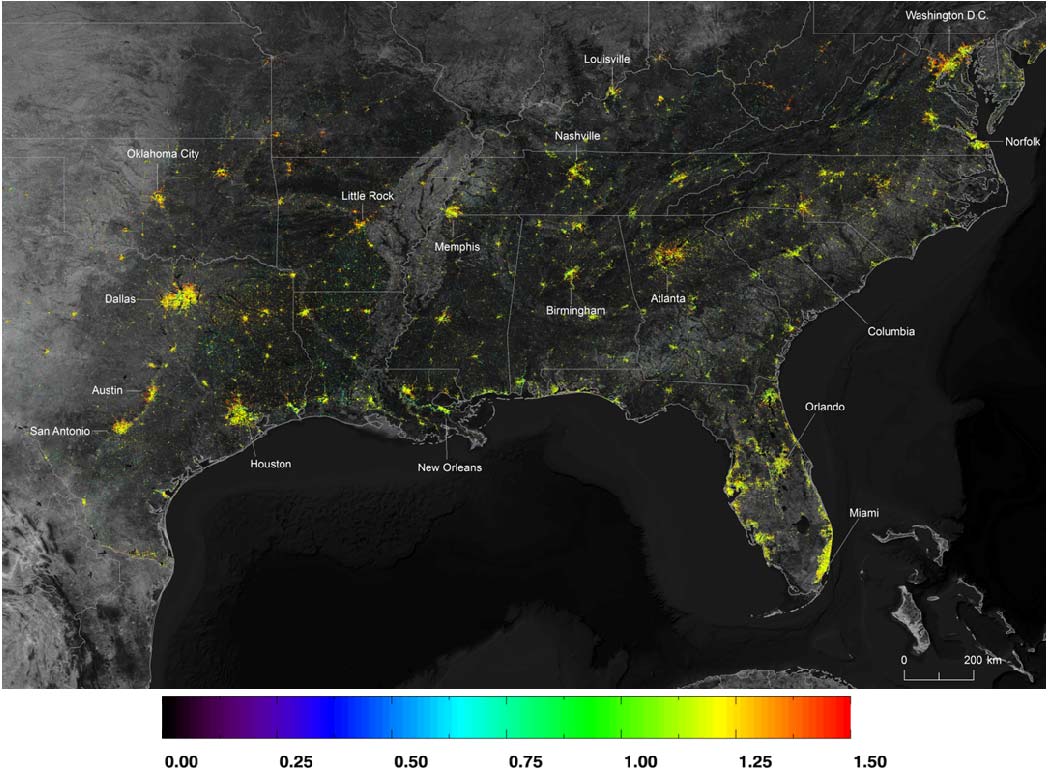
Monitoring local energy use from space

Holidays in lights: tracking cultural patterns in demand for energy services (39 page pdf, Miguel O. Román and Eleanor C. Stokes, Earth's Future , Jun. 2, 2015)

Today we review research aimed at monitoring various cultural responses at the city or neighbourhood scale level in different societies to efforts to reduce electrical power use from carbon fuel sources. The authors made us of three years of daily high resolution satellite data which showed different usage patterns based on different religious holidays (such as Christmas among Christians and Ramadan among Muslins). There appears to be potential for application of this technique to observe human behavior response in other countries world-wide.
 

Holidays in lights  

Key Quotes:

“most demand models lack basic contextual information on how dominant social phenomenon, the changing demographics of cities, and the socio-cultural setting within which people operate, affect energy decisions and use patterns.”

“Here we use high-quality Suomi-NPP VIIRS nighttime environmental products to:
(1) observe aggregate human behavior through variations in energy service demand patterns during the Christmas and New Year's season and the Holy Month of Ramadan; and
(2) demonstrate that patterns in energy behaviors closely track socio-cultural boundaries at the country, city, and district-level.”

“We processed 36 months of daily night-lights data, from early 2012 to late 2014, based on remotely-sensed estimates acquired from the Visible Infrared Imaging Radiometer Suite (VIIRS) Day/Night Band onboard the Suomi National Polar Orbiting Partnership (NPP) satellite”

“Accurate energy demand forecasting requires attention to the broader social contexts within which people operate, especially as these contexts change with globalization, economic development, and urbanization. We illustrate how the uniformities and variations between nighttime light signatures, as observed by the VIIRS instrument on Suomi NPP, can provide new insights into how energy behaviors, motivated by social incentives, vary across cultural boundaries.”

“individual factors such as poverty and irregular access to infrastructure services also affect energy behavior patterns, alongside macro-cultural forces.”

 “A globally systemic assessment of these activity patterns will lead to improved understanding of neighborhood-level energy intelligence, as well as conservation strategies that can be tailored to specific communities and socio-cultural contexts.”

Thursday, August 13, 2015

How Do Electric Fields under High Voltage Power Lines Compare to Those Near Highways?

Comparison of charged nanoparticle concentrations near busy roads and overhead high-voltage power lines (Abstract, E.R. Jayaratne, X. Ling, L. Morawska, May 28, 2015)

Also discussed here: Roadside air can be more charged than under a high-voltage power line (Science Daily, May 28, 2015)

Today we review research from Brisbane, Australia, comparing the number of charged particles emitted by vehicles near highways to what is found under power lines. Results indicate more than twice as many charged vehicles near roads. The charges alone do not present a health hazard but the fact that the particulates are charged means that they adhere more closely to the lungs when they are breathed in – and this as earlier research has shown presents a number of health impacts which would be increased by the electrical charging

 freeway electric field  

Key Quotes:

 “ a large number of charged particles in urban environments come from motor vehicle emissions ….within 10 metres of a freeway, charged particles were up to 15 times more concentrated than beneath high-voltage power lines."

 “the concentration of charged nanoparticles found near two freeways carrying around 120 vehicles per minute exceeded the corresponding maximum concentrations under two corona-emitting overhead power lines by as much as a factor of 5”

“most pronounced when a significant fraction of traffic consisted of heavy-duty diesel vehicles which typically have high particle and charge emission rates.”

“while there was no evidence that breathing in air ions was a health risk, approximately one-half of the fine particles that we inhale during normal breathing are deposited in our lungs. Therefore, it is not surprising that several studies have demonstrated a link between particulate pollution from exhaust fumes and adverse health effects.”

 "We do not believe that ions are dangerous -- the danger comes from the pollutants. The ions merely assist the particles to stick to the lungs. If there are no dangerous particles in the air to attach to the ions, there is no risk of ill health."

Tuesday, August 11, 2015

Can Vitamin E Reduce the Impact of Particulate Matter on the Lungs?

Circulating Levels of Antioxidant Vitamins Correlate with Better Lung Function and Reduced Exposure to Ambient Pollution (Abstract, Cristina Menni, Sarah J. Metrustry, Robert P. Mohney, Sean Beevers, Ben Barratt, Tim D. Spector, Frank J. Kelly, and Ana M. Valdes, American Journal of Respiratory and Critical Care Medicine, May 15, 2015)

Also discussed here: Link between vitamin E, exposure to air pollution (ScienceDaily, May 15, 2015)

And here: Can vitamin E protect lungs from air pollution? (Indo-Asian News Service, May 15, 2015)

Today we review research into the role that vitamins plays in lessening the damage to the lungs that particulate matter plays through oxidative attacks. Results indicate that higher exposure to PM 2.5 and PM10 had lower levels of vitamin E and lower levels of lung function.

 lungs-main  

Key Quotes:

“These new findings are consistent with previous reports which observed lower levels of vitamin E in people with lung conditions such as asthma…However, we do not yet fully understand which types of particulate pollution specifically damage the lungs or which vitamins best interfere with this pathway to reduce the level of damage,”

“The strongest association both with PM2.5 and FEV was seen with vitamin E. Individuals with a higher exposure to PM2.5 had significantly lower levels of alpha-tocopherol and also had lower lung function. These findings provide further evidence supporting the theory that PM damages lungs through oxidative attack while alpha-tocopherol acts to minimise oxidative injury.”

“looked at the association between lung function and a set of metabolites – chemical signatures circulating in the blood – and between these metabolites and exposure to PM10 and PM2.5”

"The researchers found that individuals with a higher exposure to PM2.5 had significantly lower levels of vitamin E and also had lower lung function”

Thursday, August 6, 2015

Exposure of New Born Babies to Traffic-Related Air Pollution

 Perinatal Exposure to Traffic-Related Air Pollution and Atopy at 1 Year of Age in a Multi-Center Canadian Birth Cohort Study (32 pge pdf, Hind Sbihi, Ryan W. Allen, Allan Becker, Jeffrey R. Brook, Piush Mandhane, James A. Scott, Malcolm R. Sears, Padmaja Subbarao, Tim K. Takaro, Stuart E. Turvey, and Michael Brauer, Environmental Health Perspectives, Mar. 31, 2015) 


Today we review research into the impact of short and longer term exposure to traffic related pollution on one year old babies. Results indicate a greater risk of allergies, especially for those who did not attend daycares with older children who seem to offer protection.
 
Mast cells are involved in allergy. Allergies ... 
Mast cells are involved in allergy. Allergies such as pollen allergy are related to the antibody known as IgE. Like other antibodies, each IgE antibody is specific; one acts against oak pollen, another against ragweed. (Photo credit: Wikipedia)[/caption]  

Key Quotes: 

"With the increasing rates of allergies amongst children in Canada and elsewhere, we were interested in determining if air pollution from traffic might be partially responsible," 

 "Understanding which environmental exposures in early life affect the development of allergies can help tailor preventative measures for children," 

"We also found that children who attended daycare or with older siblings in the household were less likely to develop allergic sensitization, suggesting that exposure to other children can be protective." 

“exposure to NO2 during the first year of life, but not during pregnancy, was positively associated with atopy at age one year."

“Children at one year of age developed more sensitization to food (12.5%) than inhalant allergens” 

“TRAP exposure after birth increased the risk for development of atopy to any allergens…“This association was stronger among children not attending daycare … compared to daycare attendees”

Tuesday, August 4, 2015

Getting Germany to Carbon Neutral by 2050 - a Scenario

Germany 2050 - a greenhouse gas-neutral Country (32 page pdf, the German Federal Environment Agency (UBA), Oct. 2013)

Also discussed here: Germany 2050 - A Greenhouse Gas-Neutral Country (Das Umweltbundesamt FĂĽr Mensch und Umwelt)

Today we review a report from the German Environmental Agency (UBA) which describes a scenario for to reduce carbon emissions for that country by 90% before 2050 without any significant change in consumption or an increase in biofuels and dependence on nuclear energy – notable conditions that many other national carbon reduction plans depend on. The prime approach is a switch to renewable energy accompanied by generation of hydrogen from renewable, as a fuel for transportation and industry. Large scale increases of photovoltaic energy generation from solar panels and of wind power from turbines along the sea coasts is envisaged.

  2050 germany renewables  

Key Quotes:

“The long-term final energy demand in a greenhouse gas-neutral Germany has been estimated to be approx. 466 TWh/a for power generation, 305 TWh/a for heating fuel, 552 TWh/a for motor fuel and 282 TWh/a for renewable inputs in the chemical industry”

 “It is not possible to meet all energy demands with electricity from renewable sources alone. Mainly in the transport sector, and especially in aviation and shipping, electricity cannot always be used directly.”

“With a share of approximately 50 % (199 TWh/a) in the final energy mix of the industry sector, renewably produced methane will be the main energy carrier in 2050, followed by renewable power with a share of approximately 45 %”

“ecological agriculture will have expanded to 20 % of the agricultural land.. no biomass will be grown in Germany for the sole purpose of energy use.. these recommendations champion a significant reduction of meat consumption and an increased use of vegetables.”

“No additional expansion of residential and traffic areas is anticipated for 2050. It is assumed that there will be a linear decline in land use from 80 hectares per day in 2007 to 30 hectares per day in 2020XIII, reaching the zero target by 2050”