Tuesday, August 9, 2011

Suburban Sprawl, Road Building and Vehicle Emissions

Major cities - per capita petrol use vs. popul...Image via WikipediaLock-in Effects of Road Expansion on CO2 Emissions: Results from a Core-Periphery Model of Beijing ( 39 page pdf, Alex Anas and Govinda R. Timilsina, Working Papers, State University of New York at Buffalo, Jun. 9, 2010)

By applying a traffic speed model to the megacity of Beijing, today’s review article examines the relationship between the addition of urban roads to traffic speed and emissions of CO2 and to what extent public transit plays an offset role for these emissions.


Key Quotes:

“Adding urban roads alleviates congestion, speeds up traffic and lowers CO2 in the intensive

margin (per car-km). But faster traffic attracts more car-trips in the extensive margin”

“The combined effect often increases aggregate emitted CO2. How much can improving public transit offset the higher emissions caused by new roads?”

“effective antidotes to substantial road expansion in the periphery of megacities:
  1. to make improvements in transit service in the periphery - drawing peripheral trips away from the car and onto transit.
  2. to reduce the core’s road capacity - increasing congestion per km in the core and thus inducing trips to switch to other modes, and to the less congested periphery”
“main drivers for the lock-in condition as it applies to developing megacities:
  1. Road capacity works powerfully in the extensive margin, overcoming the beneficial effects of the same capacity expansion in the intensive margin
  2. The relatively low market share of car trips and the large market share of the non-motorized modes that are observed in the megacities is part of the reason for the low cross-elasticity of car choice with respect to transit travel time relative to the own elasticity of car choice with respect to the travel time by car
  3. The presence of a large number of non-motorized travelers switching to bus dilutes the beneficial effects of car trips switching to transit
“Reducing roads in the core or making faster transit in the periphery draws population to the less congested periphery. While such a shift adds to urban sprawl, aggregate emissions are lowered and there is relatively less lock-in from adding peripheral road capacity”
Enhanced by Zemanta

Monday, August 8, 2011

Australian Tax and Environmental Price Reform

New ERP Gantry at Hill ViewTax Reform: Next Steps for Australia (42 page pdf, Commonwealth of Australia 2011)

Also discussed here: Australian Federal Government floats road pricing in new tax discussion paper (Road Pricing, Jul. 28, 2011)

Australia, Germany and the UK and a few other countries have governments whose policies are influenced by a party that promotes environmental and economic sustainabilility and keeps in power the party leading government, as long as its policies reflect the political reality. The minority Labour government in Australia is proposing a number of tax reforms including several that include environmental price reform in response to congestion, climate change and the graying population- as it affects traffic congestion, carbon fuel use and the need for equitable, used-based taxes. Portions of the Tax Reform Discussion Paper paper are quoted below.

Key Quotes:

“the costs of urban congestion are increasing, and are forecast to rise to $20 billion per annum by 2020”

“The Council of Australian Governments (COAG) Road Reform Plan is considering reforms to road charging and funding based on giving better incentives to operators by charging heavy vehicles on the basis of their mass, the roads they use, and the distance travelled”

“The AFTS review recommended that governments should consider the introduction of variable congestion pricing. Beyond that, the review commented that new technologies may further enable wider application of road pricing if proven cost-effective”

“The carbon price arrangements that the Government announced on 10 July 2011 are a cost effective way to achieve significant reductions in carbon pollution, by providing incentives to businesses to reduce their pollution and invest in clean energy. The two-stage plan for a carbon price mechanism will start with a fixed price period for three years, before transitioning to an emissions trading scheme

Some questions posed:
  • “Should Australia consider ways to more closely link road charging to the impact users have on the condition and upkeep of roads?
  • Is there a case to more closely link road charging to the impact users have on the level of congestion on particular roads?
  • Are there aspects of other tax arrangements that create unintended incentives for adverse environmental outcomes, or ways in which governments could use specific taxes to ensure that people take appropriate account of environmental impacts in their decision making?”
Enhanced by Zemanta

Friday, August 5, 2011

Diesel Exhaust Particulates and Heart Disease

Diesel smoke from a big truck.Image via WikipediaCombustion-derived nanoparticulate induces the adverse vascular effects of diesel exhaust inhalation (12 page pdf, Nicholas L. Mills, Mark R. Miller, Andrew J. Lucking, Jon Beveridge, Laura Flint, A. John F. Boere, Paul H. Fokkens, Nicholas A. Boon, Thomas Sandstrom, Anders Blomberg, Rodger Duffin, Ken Donaldson, PatrickW.F. Hadoke, Flemming R. Cassee, and David E. Newby. European Heart Journal Advance Access, Jul. 13, 2011)

Also discussed here: Diesel Exhaust Increases Heart Attack & Stroke Risk (Citizens for Healthy Development, Jul. 16, 2011)

And here: Bad News: Diesel Particle Emissions Cause Heart Attacks (Gas 2.0, July. 27, 2011)

Today’s review article explores the various gaseous and particulate components of exhaust from diesel motors in terms of vascular response and test various filters used to reduce health impacts.

Key Quotes:

“These associations are strongest for fine particulate matter (PM2.5) air pollution that arises from a variety of sources, including the combustion of diesel fuel by automobiles.. thought to explain the association between transient exposure to road traffic and the triggering of acute myocardial infarction”

“our present study was designed specifically to determine the role of nanoparticulate emissions, and whether the organic and inorganic surface compounds, or the carbonaceous particles themselves, are the main arbiter of the adverse cardiovascular effects”

“These particles can be filtered out of exhaust emissions through the use of particle …but these filters require consistent, expensive maintenance.”

“Experimental studies have established that diesel exhaust particles induce cellular oxidative stress and up-regulate pro-inflammatory pathways. Particle size, surface area, and surface chemistry are thought to be important determinants of these cellular effects”

“Our research shows that while both gases and particles can affect our blood pressure, it is actually the miniscule chemical particles … that are really harmful. These particles produce highly reactive molecules called free radicals that can injure our blood vessels and lead to vascular disease, … in the future we can try and remove these chemicals, and prevent the health effects of vehicle emissions.”

““people with (existing) heart disease should avoid spending long periods outside or in areas where traffic pollution is likely to be high … or near busy roads.”
Enhanced by Zemanta

Thursday, August 4, 2011

How Does Green Messaging in Transportation Affect Behaviour?

Ecopass traffic sign delimiting restricted are...The power and value of green in promoting sustainable transport behavior (11 page pdf, David Gaker, David Vautin, Akshay Vij and Joan L Walker, Environmental Research Letters Volume 6 Number 3, Jul. 26, 2011)

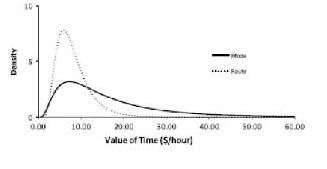
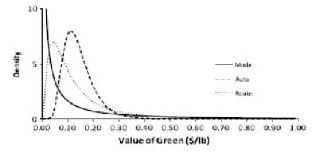
The question addressed by the review article today is how much does a “green” choice influence behavior when applied to transportation choices. The evidence presented indicates how much extra consumers are willing to pay per pound of emissions reduced (15 cents) and how this compares to how much time is saved, another strong motivator.


Key Quotes:

“While it is increasingly popular to broadcast information regarding environmental impact, little is known regarding the effects that this information has on human behavior.. whether, and to what extent, presenting environmental attributes of transport alternatives influences individual transport decisions”

“Our primary focus is to estimate the value of green (VoG). Value of time (VoT) is also of interest…. VoG and VoT are both marginal rates of substitution (MRS), equal to the tradeoff that one can make between two attributes and maintain the same level of utility. These are both willingnesses to pay where the trade-off is between a non-price attribute (CO2 for VoG and time for VoT) and the price”

“our female subjects significantly valued reducing their emissions more (7 cents more per pound) than their male counterparts”

“the attempt to make the costs more real to the subjects by paying them based on their decisions (and making a donation to an on-campus environmental fund) actually increased this group’s VoG by 11 cents per pound relative to the group who received a fixed payout”

“subjects were more willing to undertake sustainable behaviors when there was a clear environmental benefit, even with additional personal cost”

“Our basic (homogeneous) models indicate a value of green (VoG) of $0.15/pound of CO2, regardless of context (auto, mode, route) or presentation (pounds versus tons, daily versus annual)”
Enhanced by Zemanta

Wednesday, August 3, 2011

The Future of National Highways

Image representing Solar Roadways as depicted ...Image via CrunchBaseInventing the Interstate (Tom Vanderbilt. New York Times, Jul. 15, 2011)

Also discussed here: Mile upon mile of emptiness (Eric Britton, World Streets, Jul. 23, 2011)

And here: Solar Roadways

And here: Firm Nets $750K for ‘Solar Parking Lot’ (Wall Street Journal, Jul.20, 2011)


Highways are the focus of today’s review- in particular the national highway system in the USA which compares to the TransCanada Highway system in its larger neighbor to the north. Having reached a zenith in the late 1900s, as we start to see a decline in vehicle miles driven and as carbon fuel prices increase, one wonders how much longer these expensive systems will be viable. Alternatively, we are reminded of the Solar Roads project which could replace all that asphalt and polluting vehicles on these highways with non-polluting materials and emissions.

Key Quotes:

[The 1921 Federal Highway Act] “remains the single most important piece of legislation in the creation of a national network — far more so than the later Inter­state highway bill.”

“the highways of America are built chiefly of politics.”

“where congested roads would once be treated with the short-term inoculation of more lanes, a state highway official says, We don’t have enough money for that approach anymore.”

“Solar Roadways Incorporated announced that it has been awarded a follow-up $750,000 Phase II SBIR contract by the Federal Highway Administration
“This will lead to the end of our dependency on fossil fuels of any kind.. The idea is to transform the nation’s highways – often empty and baking in the sun – into a giant solar-power network”
Enhanced by Zemanta

Tuesday, August 2, 2011

What Determines Parking Rates Globally

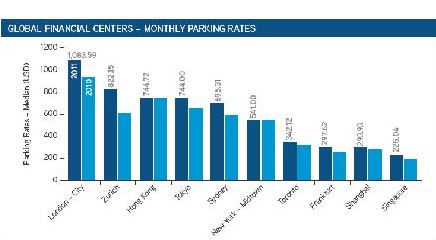
Parking Rates Broadly Up - Worldwide (4 page pdf, Ross J. Moore Chief Economist | USA, Colliers, CBD Parking Rates, 2011)

Also discussed here: Do CBD parking prices in your city look expensive when compared with alternative uses of that space? (Reinventing Parking, Aug. 30, 2010)

And here: Parking Rates Worldwide (Urban Demographics, Jul. 22, 2011)

And here: Parking charges and commercial rents – are they related (The SKM Colin Buchanan Blog, Oct. 13, 2010)

The focus of today’s review is an update on a comparison of central business district (CBD) parking rates around the world. While one xpects them to correlate well with real estate prices, one finds considerable differences, not only within a city but between cities. Parking rates are known to also impact on the degree of traffic congestion with higher rates favouring less congestion as a rule along with reduced vehicle emissions in downtown urban areas.


Key Quotes:

“One possible way to look at the question of which prices are 'too high' or 'too low' is to compare the parking prices with the rents for other uses of space (both measured per square meter per month)”

“parking is a use of real estate..Space that is not used for parking could be used for some other real-estate use”

“We have cities near the diagonal line where CBD parking rents per square metre are comparable with Grade A office rents.. At the other extreme, Delhi and Mumbai in the upper left part of the graph have expensive office space but extremely cheap parking.. Jakarta and Bangalore at the bottom left have quite cheap office space and even cheaper parking”

Hong Kong and Tokyo are also intriguing. Their CBD parking prices are among the highest in the world.… such parking prices are not surprising given their expensive CBD real-estate generally”

“It is notable how much car parking charges vary even within a small city centre area so while there is no guarantee that the data used is representative of average car parking charges in each city centre”
Enhanced by Zemanta

Monday, August 1, 2011

Does Traffic Air Pollution Cause Cervical and Brain Cancer?

Micrograph of an adenosquamous carcinoma. Uter...Image via WikipediaAir pollution from traffic and cancer incidence: a Danish cohort study (33 page pdf, Ole Raaschou-Nielsen, Zorana J Andersen, Martin Hvidberg, Steen S Jensen, Matthias Ketzel, Mette Sorensen, Johnni Hansen, Steffen Loft, Kim Overvad and Anne Tjonneland, Environmental Health 2011, 10:67, Jul. 19, 2011)

The article reviewed today looks at exposure to traffic–related air pollution and its impact on various organs in addition to the well-studied impact on the heart and respiratory system. The conclusions indicate a significant link to cervical and brain cancer as well as impacts on the liver and kidney.

Key Quotes:

Ultrafine particles, < 100 nm in diameter… constitute about 50% of the total surface area of deposited particles in the lung [4]. The airways are the primary target organs, ..ultrafine particles can translocate to other organs, such as the liver, kidneys, heart and brain”

“Air pollution at a location is calculated as the sum of three contributors:
  1. local air pollution from street traffic, calculated from input data on traffic (intensity and type), emission factors for the car fleet, street and building geometry, and meteorology;
  2. urban background, calculated from data on urban vehicle emission density, city dimensions, and building heights; and
  3. regional background, estimated from trends at rural monitoring stations and from national vehicle emissions”
“This study shows an exposure–response association between concentration of NOx at residence and risk for cervical cancer

“We found an exposure–response association between NOx at the residence and risk for brain cancer, which was almost doubled for people living close to a street with high traffic density”

“the risk for kidney cancer increased with NOx concentration at the residence”
Enhanced by Zemanta