Showing posts with label Environmental health. Show all posts

Tuesday, December 22, 2015

Getting Inertia and Effectiveness into Meeting the Climate Change Challenge

UNFCCC before and after Paris – what's necessary for an effective climate regime? (22 page pdf, Lukas Hermwille, Wolfgang Obergassel, Hermann E. Ott, Christiane Beuermann, Wuppertal Institute for Climate, Environment and Energy, Nov. 26, 2015)

Today we review a paper that examines the history, goals and structure of the UN Framework for Global Climate Change (UNFGCCC) and its failure to date of limiting GHG emissions. Part of the reason for this failure was its narrow focus on GHG emissions and for the Kyoto Protocol, unlike most environmental agreements, limiting participation to a short list of major emitting, developed countries with no role for developing countries. What is called for is a climate team approach to which those countries with ambitious goals are allowed to lead and with carbon trading attracting others to join the team. Also of note is the need for non emission goals such as progress on poverty and social conditions to count as credits for developing countries. UNFGCC diagram  

Key Quotes:

“The UNFCCC as an outcome of the Rio process was the first prominent international treaty in which the precautionary principle was formally adopted and the climate change debate contributed greatly to establishing and diffusing the precautionary principle into a wide range of jurisdictions “

“Combating climate change needs transformative change of all major socio-economic systems globally …For these transformations, the UNFCCC process and its associated policy processes have a catalyst function to translate the physical challenge of global climate change into socio-economic systems around the globe.”

“The move away from Kyoto-style binding and collectively agreed QELROs towards a bottom-up approach in which countries make non-binding pledges may well reflect the inability to effectively draw on structures of domination, that is, defining, allocating, and exercising control over resources, at the international level. The consensus-based decision-making rules of UNFCCC and the Kyoto Protocol further aggravate this problem”

“Opening up the UNFCCC discourse to a broader perspective would probably be especially relevant for developing countries, which have, as the Convention recognizes, economic and social development and poverty eradication as first and overriding priorities.. To enhance the potential of the UNFCCC to provide shared meaning and legitimitation for political action, emission targets should therefore be complemented by other types of contributions.”

“For the UNFCCC, some have proposed that only countries with absolute caps on economy-wide, sectoral or jurisdictional emissions should be allowed to participate in international emissions trading mechanisms ..A variant for a club outside the UNFCCC could be an agreement among its members to not trade emission units with non-members. The larger the club, the more this would constitute an incentive for non-members to join”

Thursday, August 21, 2014

How Does Air Pollution Affect Natural Ecosystems?

Effects of air pollution on European ecosystems- Past and future exposure of European freshwater and terrestrial habitats to acidifying and eutrophying air pollutants (42 page pdf, European Environment Agency, Jun. 30, 2014)

Also discussed here: Effects of air pollution on European ecosystems (Diego Fdez-Sevilla, Press release, European Environment Agency technical report, Jun. 30, 2014)

Today we review a report describing progress made by European countries in reducing air pollution from burning vehicle emissions and the use of agricultural fertilizers over the last decade or two, with respect to the impact it has on the natural environment which is impacted when critical thresholds or loadings are exceeded. While action on acid rain has almost eliminated the SO2 acidification impacts, eutrophication continues to be a problem in southeast-central Europe where fish and flowering plants are impacted. More than 50% of the ecological systems will still be at risk of excessive nutrient N deposition in 2020.


ecology and air pollution  

Key Quotes:

 “ This report focuses on the deposition of airborne sulphur (S) and nitrogen (N) compounds and their negative effects on ecosystems. N- and S-containing air pollutants are released to the atmosphere by combustion processes such as the burning of coal or petrol, and by non-combustion processes such as agricultural fertiliser application”

“an ecosystem is at risk of acidification or eutrophication when its critical load is exceeded by acidifying and eutrophying air pollutants, respectively. When critical loads are exceeded the actual damage to sensitive elements of an ecosystem may involve a time delay, dependent on soil, water and vegetation properties as well as combined effects due to for example climate change” 

“Although air pollution does not cause as much harm as it once did, we are still struggling to protect sensitive ecosystems from harmful effects such as eutrophication. This changes habitats, endangering a wide range of species from fish to flowering plants. It is particularly striking that the problem appears to be just as bad in Europe’s protected natural areas.”

“As SO2 emissions have fallen, the relative contribution made by ammonia (NH3) emitted from agricultural activities and nitrogen oxides (NOX) emitted from combustion processes to surface water and soil acidification has increased or even become predominant in some regions in Europe. NH3 and NOX are also eutrophying air pollutants.”

“When implementing current legislation, more than 50 % of the ecosystem areas classified according to the EUNIS habitats classification are expected to be still at risk of excessive nutrient N deposition in 2020.”

Friday, June 27, 2014

How Can We Find the Most Environmentally Sustainable Place in the World?

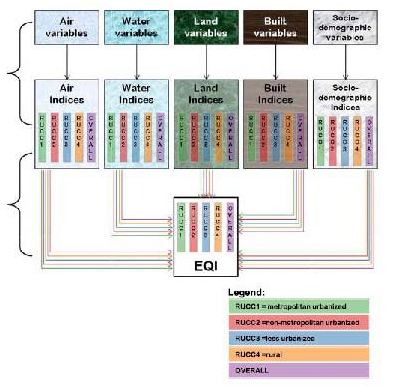
Construction of an environmental quality index for public health research (39 page pdf, Lynne C Messer, Jyotsna S Jagai, Kristen M Rappazzo, Danelle T Lobdell, Environmental Health, May 22, 2014) Today we review research aimed at developing a more accurate index of environmental quality than traditional indices used to select the greenest or healthiest or highest environmental quality of a place in the world. The older indices tend to use spot observations of a single indicator to represent an area or ambient value, and they tend not to consider a combination of several variables to evaluate land, air, water, built environment and socio-demographic conditions. An example of the latter is the difference in crime rates between urban and rural areas where the latter would feel safer and have a higher environmental quality than the former, all other variables constant. On the other hand, some urban areas have a better built environment (more bike and pedestrian paths, etc) than some rural areas where highway deaths are higher.

The proposed Environmental Quality Index (or EQI) uses 22 performance indicators to estimate environmental sustainability for all the counties in the USA. The resulting indices were weighted so that there were an equal number of regions at the low end as well as at the high end of the index scale. As the authors note, the EQI represents only the outdoor environment and indoor conditions may, on occasion, be more important from a health point of view or need to estimated from a different set of variables.

 env index 

Key Quotes:

“The empirical characterization of environmental conditions, however, is challenging because the non-residential ambient environment comprises an almost uncountable array of complex mixtures, which are difficult to quantify simultaneously… rarely, if ever, are multiple environmental domains combined, even though we know humans are exposed to these multiple environmental domains simultaneously”

“Here we describe a method of constructing an environmental quality index (EQI) representing multiple domains of the non-residential ambient environment, including the air, water, land, built and sociodemographic domains.”

“We developed an Environmental Quality Index for all counties in the United States incorporating data for five environmental domains: air, water, land, built, and sociodemographic. For each environmental domain, variables were constructed to represent exposures within that domain; indices for each domain and for environmental quality as a whole were developed by stratifying by rural–urban continuum codes. Variable loadings varied by domain and rural–urban designation, suggesting that environmental quality is driven by different domains in rural and urban areas.”

“The EQI is focused mostly on the outside environment, which may not be the most relevant exposure in relation to human health and disease.”

Wednesday, October 2, 2013

Aging, Fertility and Migration as Environmental Drivers

For Fast-Growing Countries, Should Aging Be a Concern? Planning for the Second Demographic Dividend(Elizabeth Leahy Madsen, New Security Beat, Environmental Change and Security Program, Wilson Center, Sep. 10, 2013)

Also discussed here: World population projected to reach 9.6 billion by 2050 with most growth in developing regions, especially Africa – says UN(UN Press Release, Jun13, 2013)

And here: Population Aging and Economic Growth in Asia(30 page pdf, David E. Bloom, David Canning, and Jocelyn E. Finlay, the National Bureau of Economic Research, University of Chicago Press, Aug. 2010)

Today we review recent population analyses which focus on the combined effect of the aging society with lower fertility and increased migration (in some countries) and the trends expected through this century. The reason this topic was examined is the increase in vulnerability to exposure to air pollution and the health impacts, seen in many studies of the elderly. While pointing out that consumption (and therefore pollution) increases from childhood through to senior years, from an economic point of view, aging by itself is not a negative aspect provided those in their working years plan for their retirement income - which given the recent tendency of the state to retreat from this responsibility would or should encourage more self reliance. That in turn could translate into a greater ability to maintain quality of life and of the environment.

We’ll see!

figure1-population-65  

Key Quotes:

“while aging does present genuine policy challenges, it is not universally negative. If the right conditions are in place, countries can even experience an economic bonus..as their age structures mature.”

 “Unlike children, older adults are not inherently dependent on others to support them. Elderly people have decades of accumulated knowledge and experience and, as life expectancies rise along with progress through the demographic transition, their longer and healthier lives are often more productive.”

 “Just as governments have decades of advance notice that their populations are aging, most individuals hope and expect to live to old age and plan accordingly. Their accumulated savings act as investments that drive economic growth.. elderly adults are more likely to provide financial support to their children and grandchildren than vice versa.”

“In 2010, a total of 19 countries experienced a decline of at least 1,000 people in their population compared to 2009… All of them, except Cuba and Puerto Rico, are located in Eastern and Southern Europe…In five countries, including the two in the Caribbean, there are still more births than deaths, but high outward migration rates create population decline”

“By 2030, the number of countries experiencing population decline is projected to increase from 19 to 34… The potential declines in Japan and Russia are most dramatic; both have current fertility rates below 1.5 children per woman.”

“From 1960 to 2005, China experienced the largest absolute increase in life expectancy in the world.. Japan boasts the highest life expectancy in the world at 85.6 for women and 78.7 for men, and it continues to rise... as the total fertility rate falls below the replacement rate in many Asian countries, the working- age share will decrease in the long run”

“The major reason population aging matters is that human productivity and human consumption have different time profi les. Children consume more than they produce… lasts into the late twenties in many countries as they continue in advanced education. Between twenty- five and roughly sixty- five are the prime working years, in which production exceeds consumption. After age sixty-five, consumption exceeds labor income.”
Enhanced by Zemanta

Wednesday, June 12, 2013

Roadside Emissions and Kidney Disease

Kidney
Kidney (Photo credit: Joshua Schwimmer)

Also discussed here: Diesel emissions harming kidneys(Dr Cory Couillard, VibeGhana, May 14, 2013) 

Today we review some research indicating that those who breathe particulates near busy roads risk not only a higher risk of cardiovascular disease but also kidney disease. Results indicate that when the proximity is less than 50 m can cause a relative aging of 4 years. 

Key Quotes: 

“Living near major roadways has been associated with increased risk of cardiovascular events, but little is known about its impact on renal function.” 

 “An average person breathes 22,000 times a day and takes in 16 kg of air each day” 

“Diesel petrol has been discovered to contain tiny particles that can injure blood vessels and prevent them from contracting and relaxing properly. The blood flow disturbance increases the risk of blood clots in the heart and decreases the overall function of the kidneys.” 

 “Living near a major roadway is associated with lower eGFR [estimated glomerular filtration rate]in a cohort of patients presenting with acute ischaemic stroke. If causal, these results imply that exposures associated with living near a major roadway contribute to reduced renal function, an important risk factor for cardiovascular events.” 

 “Comparing patients living 50 m versus 1000 m from a major roadway was associated with a 3.9 ml/min/1.73 m2 lower eGFR .. a difference comparable in magnitude to the reduction in eGFR observed for a 4-year increase in age in population-based studies.”

 “If causal, these results imply that exposures associated with living near a major roadway contribute to reduced renal (kidney) function, an important risk factor for cardiovascular events”
Enhanced by Zemanta

Friday, May 31, 2013

Measuring Health Rate Variability near Traffic

English: Oxidative stress process Italiano: Pr...
English: Oxidative stress process Italiano: Processo dello stress ossidativo (Photo credit: Wikipedia)

PM2.5, oxidant defence and cardiorespiratory health: a review(15 page pdf, Scott A Weichenthal,Krystal Godri-Pollitt, Paul J Villeneuve, Environmental Health, May 4, 2013) 

Today we review research aimed at seeing if there is a significant link between oxidative stress and the cardiovascular health impacts, arising from exposure to high levels of PM2.5- and if so, the value of oxidative burden as a metric. Results indicate there is an inverse relationship between heart rate variability (HRV) and PM2.5 which may be useful when assessing health threats from proximity to vehicle emissions in heavy traffic.  

Key Quotes: 

“Of the plausible biological mechanisms explaining PM2.5 health effects, oxidative stress is often cited as playing an important role in both respiratory and cardiovascular outcomes”

 “Here we review epidemiological evidence related to the role of oxidative stress (and oxidant defence) in PM-induced cardiorespiratory morbidity.” 

“stronger inverse associations were observed between PM2.5 and HRV among subjects with genetic polymorphisms that impaired oxidant defence;” 

“a polymorphism in the enzyme needed to produce reduced glutathione (important for oxidant defence) was found to modify the impact of PM2.5 exposure on lung function growth among children,” 

 “Conceptually, PM oxidative burden is an appealing exposure metric for epidemiological analysis as it aims to capture the ability of PM to modify a biological process known to contribute to adverse cardiorespiratory health effects…. little evidence is available to gauge the potential role of this metric in ambient air quality management.” 

“oxidative potential measures from this assay have been shown to vary with proximity to important sources of air pollution such as traffic..and further evaluation of an expanded set of health outcomes with both acute and chronic exposure intervals are required before the validity of this measure can be fairly assessed.”
Enhanced by Zemanta

Monday, April 8, 2013

The Impact of Air Pollution on Children's Respiratory Diseases World-wide

Ambient particulate air pollution and acute lower respiratory infections: a systematic review and implications for estimating the global burden of disease(15 page pdf, Sumi Mehta, Hwashin Shin, Rick Burnett, Tiffany North & Aaron J. Cohen, Air Quality, Atmosphere & Health, May 21, 2011)

Today we summarize a literature review that examined the link between indoor and outdoor air pollution and respiratory diseases world-wide, with a focus on young children 20% of whom die of this. The sources of the air pollution range from PM 2.5 from combustion to the burning of solid fuels indoors.


resp impact from pm25


Key Quotes:

“Acute lower respiratory infections (ALRI) account for nearly one fifth of mortality in young children worldwide and have been associated with exposures to indoor and outdoor sources of combustion-derived air pollution.”

 “ALRI defined as acute cough or difficulty in breathing with indrawing of the lower chest wall necessitating hospital admission" “each 10-ÎĽg/m3 increase in long-term ambient PM2.5 concentrations is associated with around a 12% increased risk of ALRI incidence”

“with respect to estimating of the global burden of ALRI attributable to air pollution, are the cohort studies that relate ALRI occurrence to annual average PM2.5 concentrations… PM2.5 is the most consistent and robust indicator of air pollution from combustion sources that can be estimated for all global regions”

“young children exposed to household air pollution from unprocessed household solid fuel use had a 1.8 (95% CI 1.5–2.2) fold greater risk of pneumonia compared to unexposed children”

“The capacity for combustion-derived air pollution to affect resistance to infection is well-documented.. adverse effects of exposure to outdoor air pollution can be estimated even in populations where total exposure to combustion-derived PM is dominated by PM from other sources, including smoking and household air pollution from cooking with solid fuels”

“The cohort studies reviewed here were conducted in developed countries with relatively low levels of air pollution; the highest average PM2.5 concentration reported in these studies is 25 ÎĽg/m3, while concentrations in less developed countries can be several times greater”
Enhanced by Zemanta