Monday, July 4, 2011

Podcars in England

Personal rapid transit (Wikipedia)

Also discussed here: Monorail plan back on track? (Milton Keys Citizen, Jun. 26, 2011)

Also here: Evaluation and Demonstration of Innovative City Transport Final Report (EDICT) (54 page pdf, European Commission - DG Research, Dec. 2004)

And here: Personal Rapid Transit Vehicles in Masdar City (Pollution Free Cities, Feb. 8, 2011)

Today’s story comes from Milton Keynes a small town of around 200,000 in southeast England which recently commissioned a report on the feasibility of monorail podcars or a personal rapid transit system, as part of a transportation strategy for the next 20 years. This comes following the introduction of operational systems in Masdar City, UAE in November 2010 and at Heathrow Airport to connect its terminal to the parking lot. What is interesting these developments is the concept of a car-free community whose transportation needs are met by small, emission-free robot cars. Similar systems are being planned in South Korea and India, according to the Wiki reference.


Key Quotes:

“A MONORAIL system running alongside city grid roads could revolutionise public transport in Milton Keynes”

“Car-orientated urban designs such as that of Milton Keynes, far from being exemplar, are viewed professionaly as environmentall irresponisble, economically extravagant, risky and socially diverse,”

“It is viable to build a small network that would connect CMK destinations to the railway station and key car parks for around £10 million,”

“A PRT system (by 2getthere) went into operation in Masdar City in the UAE in November 2010. The system has 10 passenger and 3 freight vehicles serving 2 passenger and 3 freight stations connected by 1.2 kilometers of one-way track”

“A pilot system at London Heathrow Airport, United Kingdom, was constructed using the ULTra design. Originally scheduled to be operational in 2009, it recently underwent 4 weeks of public trials where it achieved a 99.6% availability”

“the EDICT project, sponsored by the European Union, conducted a study on the feasibility of PRT in four European cities. The study involved 12 research organizations, and concluded that PRT:[6]
  • would provide future cities "a highly accessible, user-responsive, environmental friendly transport system which offers a sustainable and economic solution."
  • could "cover its operating costs, and provide a return which could pay for most, if not all, of its capital costs."
  • would provide "a level of service which is superior to that available from conventional public transport"
  • would be "well received by the public, both public transport and car users."
Enhanced by Zemanta

Thursday, June 30, 2011

Managing Traffic Congestion in Melbourne, Australia

Final Report, Making the Right Choices: Options for Managing Transport Congestion (568 page pdf, Victorian Competition and Efficiency Commission, Sept. 14, 2006)

Also discussed here: Govt says 'no go' on city car tax (Herald Sun, Jun. 19. 2011)

And here: Managing Traffic Congestion with Rewards (Pollution Free Cities, Jun. 15, 2011)

Today's focus is on the comprehensive studies of the need for congestion pricing in Melbourne Australia and the difficulty in getting public support for that. Trends indicate that the already multi-billion dollar economic losses due to traffic congestion will only get worse without that demand management tool.


Key Quotes:

“The economic costs of congestion in Melbourne currently range from $1.3-2.6 billion per year, and are probably closer to the lower figure. These costs could double in fifteen years if further measures are not taken to address congestion”

“A comprehensive Melbourne road charging study would be useful to understand better the benefits of road use charging in a future environment where congestion may be increasing, and to permit a comparison of these benefits with the costs of this form of demand management”
Enhanced by Zemanta

Wednesday, June 29, 2011

Improving Knowledge and Communication for Decision Making on Air Pollution and Health in Europe

Aphekom

Also discussed here: Aphekom (Improving Knowledge and Communication for Decision Making on Air Pollution and Health in Europe)

And here:

Traffic Air Pollution and Health Impacts in Urban Italy (Pollution Free Cities, May 20, 2011)

Today’s review article is a summary of the work of the Aphekom project in Europe over the last 3 years. It points to findings which show that living near busy roads (defined as those with typically more than 10,000 vehicles per day) present a significant health risk in terms of reduced life expectancy and health costs.


Key Quotes:

“on average, over 50% of the population in the 10 European cities studied lives within 150 metres of roads travelled by 10,000 or more vehicles per day and could thus be exposed to substantial levels of toxic pollutants”

“on average for all 10 cities studied, 15-30 per cent of exacerbations of asthma in children, acute worsening of COPD and acute CHD problems are attributable to air pollution”

“estimated an economic burden of more than Euro 300 million every year attributable to chronic diseases caused by living near heavy traffic…Our work suggests the total benefits of reducing traffic exposure for urban populations may have been largely underestimated until now"
Enhanced by Zemanta

Tuesday, June 28, 2011

Urban Form and Greenhouse Gas Reductions

An Assessment of Urban Form and Pedestrian and Transit Improvements as an Integrated GHG Reduction Strategy (117 page pdf, Dr. Lawrence D. Frank, Michael J. Greenwald, Sarah Kavage, Andrew Devlin, Washington State Department of Transportation, Apr. 1, 2011)

Also discussed here: VMT Spreadsheet (Excel spreadsheet estimate of GHG emissions of simple land use projects or plans)

And here: How Can Large Cities Reduce Greenhouse Gas Emissions (Pollution Free Cities, Jun. 9, 2011)

Today’s article under review looks at transportation demand management in and around Seattle, Washington as a way of reducing greenhouse gases, given that the biggest contributer is cars and trucks (as in other cities with little industry, such as Ottawa, Canada). The report found that parking rates, sidewalk width and transit availability (in that order) had the closest link to the use of cars (as measured by VMT) and CO2 emissions.


Key Quotes:

“to test the effect of sidewalks on travel patterns and ..to relate sidewalk availability with VMT and GHG emissions”

“[in the state of Washington] the transportation sector currently accounts for approximately 45% of total GHG emissions, with 73% of these emissions resulting from passenger cars and trucks fueled by gasoline and diesel. By 2020, statewide transportation emissions are anticipated to account for nearly 57% of total emissions..”

“At the local level, the City of Seattle Climate Protection Initiative aims to reduce citywide greenhouse gases by 80% below 1990 levels by 2050”

“Increasing sidewalk coverage from.. 30 percent of all streets to..70 percent of all streets was estimated to result in a 3.4 percent decrease in VMT and a 4.9 percent decrease in CO2”

“Parking cost had the strongest associations with both VMT and CO2. An increase in parking charges from approximately $0.28 per hour to $1.19 per hour ..resulted in a 11.5 percent decrease in VMT and a 9.9 percent decrease in CO2”

“ developed and tested a simple spreadsheet tool.. to estimate the potential reduction in CO2 and VMT due to urban form, sidewalk coverage, transit service and travel cost changes… where scenario analysis or impact assessment is appropriate – for example, comprehensive or neighborhood planning, transit-oriented development, or transit corridor planning”

“Statistical model results demonstrate that travel pricing and demand management strategies yield consistently large and significant influence on VMT and CO2 generation”
Enhanced by Zemanta

Monday, June 27, 2011

Building Resilience in Cities Adapting to Climate Change

Financing the Resilient City- A demand driven approach to development, disaster risk reduction, and climate adaptation (48 page pdf, Jeb Brugmann, ICLEI - Local Governments for Sustainability, June 3, 2011)

Also discussed here: Financing the Resilient City, An ICLEI White Paper (4 page pdf, ICLEI - Local Governments for Sustainability, June 3, 2011)

A pollution-free city facing change must adapt. Today’s focus is on a report from Resilient Cities: World Congress on cities and adaptation to climate change sponsored by ICLEI- Local Governments for Sustainability. The report recommends a bottom-up approach, aimed at reducing systematic and catastrophic risks that sometimes may be taken on together, using local criteria to decide how to approach the challenges and how to finance them.


Key Quotes:

“a reframing of the adaptation challenge from its primary focus on risk reduction to a broader focus on increasing the performance of the area or system in which the investment is to take place.”

“ resilience as a coherent approach to future urban planning”

“urban areas..will bear up to 80 percent of the US$80-100 billion per year in climate change adaptation costs”

“Catastrophic risks arise from the poor design and location of the built environment including infrastructure, and include vulnerabilities and losses associated with flooding, violent winds, temperature extremes…”

“Systemic risks create sustained losses due to highly inefficient energy, water, food supply, and health care systems, arising from poor maintenance, old technology, and poor demand-side and lifecycle management”

“Measures to reduce poor systemic performance can be designed to reduce vulnerabilities to weather-related catastrophes, and vice versa”

“need to design infrastructure projects that are optimized according to a set of local criteria.”

“bottom-up work on GHG mitigation also provided opportunities to pilot a variety of new financial instruments, such as green bonds, revolving loan funds, consumer financing of household energy efficiency and renewable installations, tradable renewable energy certificates, feed-in tariffs, etc”
Enhanced by Zemanta

Friday, June 24, 2011

Changing Consumer Behaviour to Reach Climate Change Goals

Behaviour Change in the UK Climate Debate: An Assessment of Responsibility, Agency and Political Dimensions (20 page pdf, Shane Fudge and Michael Peters, Sustainability 2011, 3(6), 789-808, Jun. 7, 2011)

The British government is approaching its commitment to reduce greenhouse gas emissions by 80%, with a focus on ways to bring about behaviour change, in addition to the more traditional reach for a technological fix. Today’s review article summarizes the background behind the policy and the results of polling.


Key Quotes:

“Government interventions on the demand side of consumption have increasingly involved attempts to obtain greater traction with the values, attitudes and beliefs of citizens in relation to climate change and also in terms of influencing consumer behaviour at an individual level. “

“44% of all emissions are by individual households, most of which comes from four transactions: electricity and gas in our homes, and car and air travel”

“The practical difficulties of reaching increasingly stringent UK targets for CO2 emission reductions have encouraged policy-makers to embrace and promote “bottom-up” solutions in order to address, for example, patterns of consumption and lifestyles such as those associated with travel, eating habits, leisure practices and patterns of living”

“a growing concern with environmental degradation can be traced to the significance of living in a “post-scarcity society”.. Most ecological issues, including global climate change, are not to do with scarcity of resources, but with the profligate use of them. Traffic congestion and pollution are good examples. “

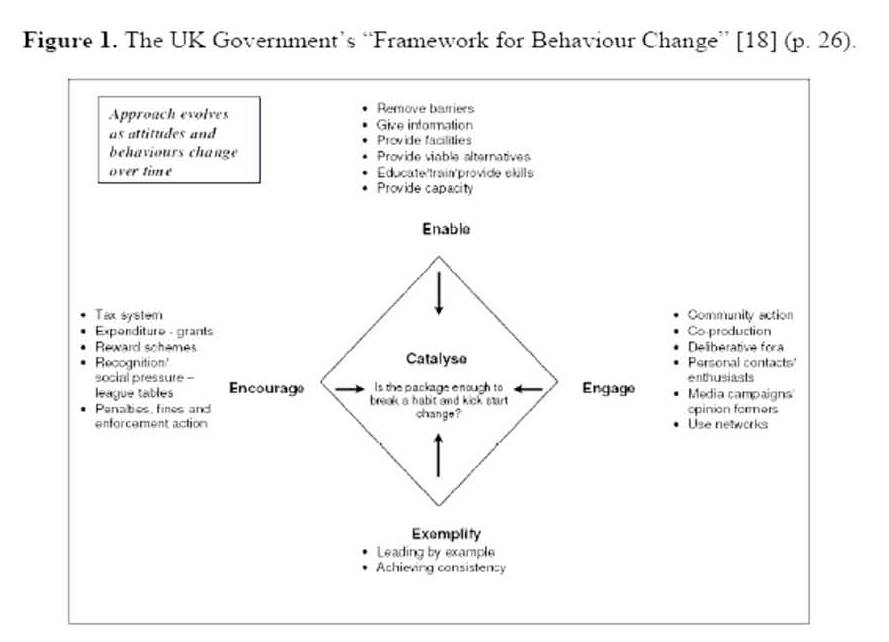
“four dimensions of the diamond model:

Enable. - be as an information provider in order to encourage the individual consumer to make more informed choices in their purchasing habits.

Engage- awareness raising campaigns which are embedded at a local level are far more likely to resonate with individuals if led by local authorities

Encourage- Various congestion charge schemes had also been developed in order to encourage less “unnecessary” journeys by private car.

Exemplify- the UK Government set a longer-term target of an 80 per cent reduction in emissions by 2050; punctuated by a series of interim targets by which political leaders will be accountable themselves.

“The issue of convenience was considered to be an important factor in participants‘ decisions with regard to both domestic energy use and purchase of appliances—almost always overriding potential environmental consequences”
Enhanced by Zemanta

Thursday, June 23, 2011

Replacing Nuclear Power with Solar Energy for Household Use

Nine Leading Companies and Fujisawa City to Collaborate on Sustainable Smart Town ProjectNine Leading Companies and Fujisawa City to Collaborate on Sustainable Smart Town Project (Panasonic News, May 26, 2011)

Also discussed here: Fujisawa Smart Town Planned for Japan to Be Most Advanced Eco City in the World (Andrew Michler, Inhabitat, May 27, 2011)

Today we look at a sustainable town being built in 2014 at Fujisawa, just west of Tokyo, that will maximize the use of photo-voltaic solar energy panels on every house. The houses are connected together with advanced communications and computer technology to provide, in effect, a single energy source that will then provide electric power for household use as well as emission-free transportation with electric vehicles.


Key Quotes:

“Fujisawa Sustainable Smart Town' will Lead the World by Installing Solar Panels and Home-use Storage Batteries in Every Household”

“The project will be built on the site of an old Panasonic manufacturing plant, and with the intense attention given to Japan’s energy future after the Fukushima disaster the eco town couldn’t come at a more apropos time”

“1,000-home smart-town that will cover about 47 acres.. population of about 3,000 people”

“The entire town will act as a single energy system. Communication systems linked to each household and each home’s appliances will manage the energy needs to balance what is coming in with what the occupants require, drawing on the battery systems to help with load management”

“The town’s design will allow it to run off the main grid during disasters, providing extra layers of security to the infrastructure. The development is aimed to be replicable throughout the world, using integrated energy technologies at large scales.”

“The town is aiming to reduce CO2 by 70% from the 1990 baseline”
Enhanced by Zemanta