Showing posts with label noise. Show all posts

Tuesday, December 27, 2016

How do Air Pollution and Noise from Road Traffic affect High Blood Pressure in Western Europe?

English: Main complications of persistent high...
English: Main complications of persistent high blood pressure. Sources are found in main article: Wikipedia:Hypertension#Complications. To discuss image, please see Template_talk:Häggström diagrams. To edit, please use the svg version, convert to png and update both versions online. (Photo credit: Wikipedia)
Long-term exposure to ambient air pollution and traffic noise and incident hypertension in seven cohorts of the European study of cohorts for air pollution effects (ESCAPE) (Abstract, Kateryna B Fuks, Gudrun Weinmayr, Xavier Basagaña, Olena Gruzieva, Regina Hampel, Bente Oftedal, Mette Sørensen, Kathrin Wolf, Geir Aamodt, Gunn Marit Aasvang, Inmaculada Aguilera, Thomas Becker, Rob Beelen, Bert Brunekreef, Barbara Caracciolo, Josef Cyrys, Roberto Elosua, Kirsten Thorup Eriksen, Maria Foraster, Laura Fratiglioni, Agneta Hilding, Danny Houthuijs, Michal Korek, Nino Künzli, Jaume Marrugat, Mark Nieuwenhuijsen, Claes-Göran Östenson, Johanna Penell, Göran Pershagen, Ole Raaschou-Nielsen, Wim Swart Jr, Annette Peters, Barbara Hoffmann, European Heart Journal, Oct. 24, 2016) 


Key Quotes: 

“Long-term exposure to air pollution is linked to a greater incidence of high blood pressure, according to the largest study to investigate the effects of both air pollution and traffic noise by following over 41,000 people in five different countries for five to nine years.” 

 “among adults, up to one extra person per 100 people of the same age group living in the most polluted areas of cities would develop high blood pressure (hypertension) compared to those living in the less polluted areas…similar to the effect of being overweight with a body mass index (BMI) between 25-30 compared to people with normal weight” 

“for every five micrograms [2] per cubic metre (5 µg/m3) of PM2.5, the risk of hypertension increased by a fifth (22%) in people living in the most polluted areas compared to those in the least polluted areas” 

“people living in noisy streets, where there were average night time noise levels of 50 decibels, had a six percent increased risk of developing hypertension compared to those living on quieter streets where average noise levels were 40 decibels during the night.” 

“there were higher average levels of pollution in the central and southern European study areas -- Germany and Spain -- than in the Scandinavian areas -- Norway, Sweden and Denmark. Exposure to traffic noise and traffic load was highest in the study areas of Sweden and Spain.”    

Tuesday, December 13, 2016

How does Air Pollution and Noise from Road Traffic affect Blood Pressure?

Car owners request measures against traffic no...
 Car owners request measures against traffic noise for the road at their home, a typical Nimby (Not In My Backyard) situation (Photo credit: Wikipedia)

Long-term exposure to ambient air pollution and traffic noise and incident hypertension in seven cohorts of the European study of cohorts for air pollution effects (ESCAPE) (Abstract, Kateryna B Fuks, Gudrun Weinmayr, Xavier Basagaña, Olena Gruzieva, Regina Hampel, Bente Oftedal, Mette Sørensen, Kathrin Wolf, Geir Aamodt, Gunn Marit Aasvang, Inmaculada Aguilera, Thomas Becker, Rob Beelen, Bert Brunekreef, Barbara Caracciolo, Josef Cyrys, Roberto Elosua, Kirsten Thorup Eriksen, Maria Foraster, Laura Fratiglioni, Agneta Hilding, Danny Houthuijs, Michal Korek, Nino Künzli, Jaume Marrugat, Mark Nieuwenhuijsen, Claes-Göran Östenson, Johanna Penell, Göran Pershagen, Ole Raaschou-Nielsen, Wim Swart Jr, Annette Peters, Barbara Hoffmann, European Heart Journal, Oct. 24, 2016)


Today we review research based on the effects of traffic –related air pollution and noise in five countries for 5-9 years. Results indicate that the risk of high blood pressure or hypertension increased by 20% for those who live in more polluted areas (for every increase of 5 µg/m3 of PM2.5) and by 6% for those living in areas with a higher level of noise. Air pollution was higher in Germany and Spain than in Scandinavian countries and the combination of air and noise pollution was higher in Spain and Sweden.

Key Quotes: 

“Long-term exposure to air pollution is linked to a greater incidence of high blood pressure, according to the largest study to investigate the effects of both air pollution and traffic noise by following over 41,000 people in five different countries for five to nine years.” 

“among adults, up to one extra person per 100 people of the same age group living in the most polluted areas of cities would develop high blood pressure (hypertension) compared to those living in the less polluted areas…similar to the effect of being overweight with a body mass index (BMI) between 25-30 compared to people with normal weight” 

“for every five micrograms [2] per cubic metre (5 µg/m3) of PM2.5, the risk of hypertension increased by a fifth (22%) in people living in the most polluted areas compared to those in the least polluted areas” 

 “people living in noisy streets, where there were average night time noise levels of 50 decibels, had a six percent increased risk of developing hypertension compared to those living on quieter streets where average noise levels were 40 decibels during the night.” 

“there were higher average levels of pollution in the central and southern European study areas -- Germany and Spain -- than in the Scandinavian areas -- Norway, Sweden and Denmark. Exposure to traffic noise and traffic load was highest in the study areas of Sweden and Spain.”

Thursday, June 30, 2016

How Does Stress Add to Health Impacts of Air Pollution?

A Framework for Examining Social Stress and Susceptibility to Air Pollution in Respiratory Health (8 page pdf Jane E. Clougherty, Laura D. Kubzansky, Environmental Health Perspectives, Sep. 2009)

Also discussed here:EPA Workshop on Interactions between Social Stressors and Environmental Hazards (Abstracts, Environmental Protection Agency, Sep. 19, 2012)

And here: London parents see toxic air as 'the biggest health threat to their children (Nicholas Cecil , Evening Standard, Mar. 21, 2016)

Today we examine a literature review into the links between psychological stresses and air pollution. Historically studies have shown that asthma is exacerbated when a person is also exposed to traffic related air pollution. Some air pollutants affect oxidative stress and cell production. Stress also may affect the permeability of bodily membranes to allow greater chemical uptake by organs including the brain. Roadway noise causes higher stress and depression as well as a higher heart rate for those who live near traffic.

  stress and aq in london  

Key Quotes:

“Limited but growing epidemiologic evidence indicates that psychological stress may also alter susceptibility to physical exposures, such as air pollution. This work examined social environmental interactions in respiratory and cardiovascular disease, such as stress-related modification of traffic-related air pollution effects on asthma etiology ..or exacerbation”

 “some air pollutants and psycho-social stress may independently affect common physiologic processes such as oxidative stress …or inflammatory cell ..production”

 “Some evidence suggests that stress may alter permeability of bodily membranes to chemical exposures,such that stress may alter systemic transport and chemical uptake into organs including the brain..facilitating combined and synergistic effects of stressors and pollution on many bodily systems.”

“Evidence suggests that roadway noise, a spatial stressor correlated with pollution, increases heart rate among adults and children ..and living in high-traffic areas predicts higher stress, lower self-reported health, and depressive symptoms .. effects distinct from those of pollution”

Thursday, April 21, 2016

How Does Noise in the City Affect Its Residents?

How City Noise Affects Residents' Health (The Atlantic , Mar. 1, 2016)

 Also discussed here: Noise and the City Blog

And here: Greater Boston Neighborhood Noise Survey (Noise and the City)

And here: Pinpointing the Health Impacts of Urban Noise

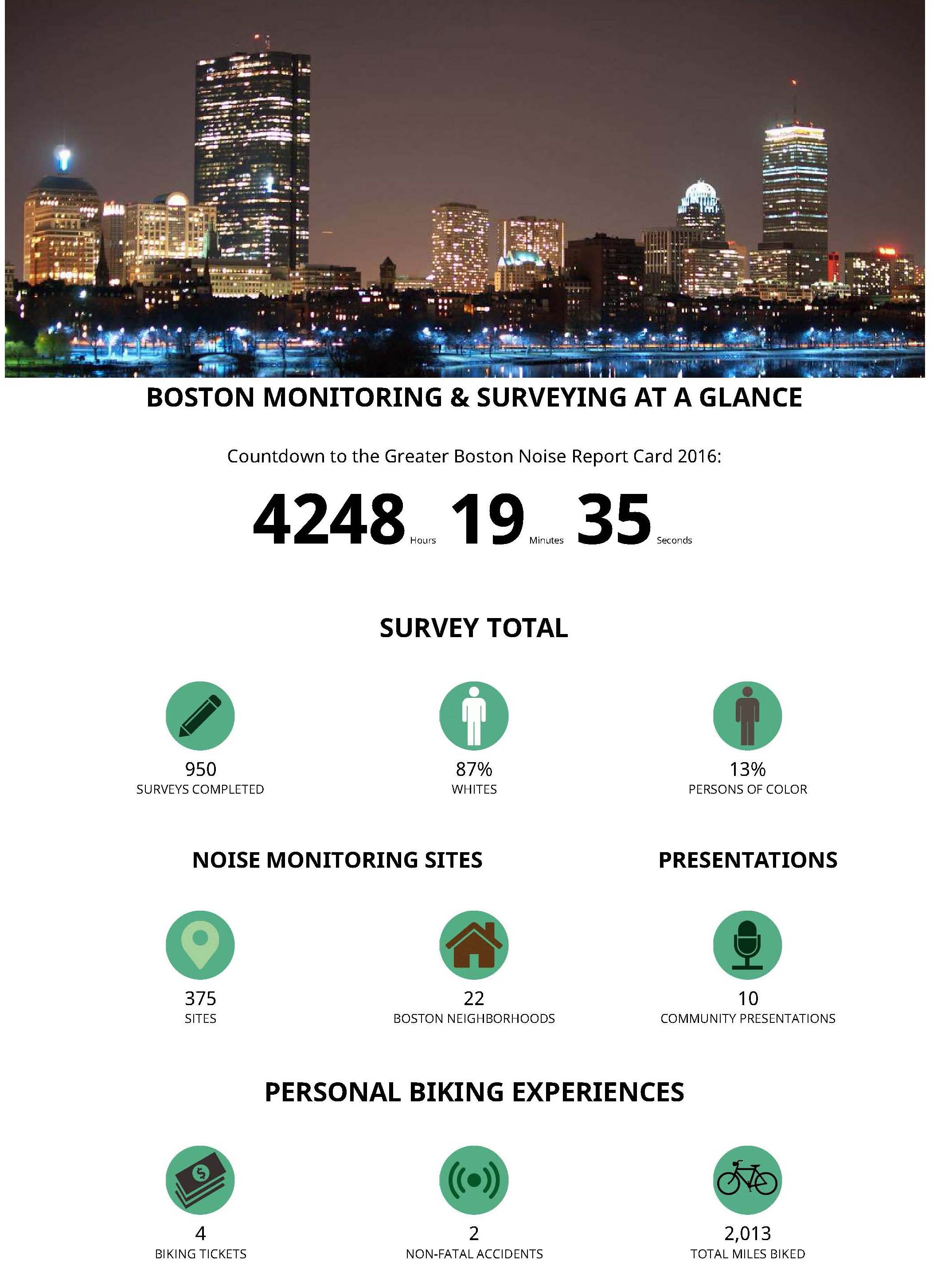
Today we review progress on a project by a PhD candidate at Harvard School of Public Health to measure and monitor the noise in neighbourhoods of a large American city (Boston) as well as conduct a survey of residents to assess their reaction to noise. The noises include traditional road noise from traffic, as well as the hidden ones such as vibrations and low frequency noises from underground subways or idling trucks. While we await her thesis, those interested in the project can follow progress at her blog at http://noiseandthecity.org/monitoring-and-surveying-at-a-glance/ .


Boston_ Monitoring and Surveying at a Glance - Noiseandthecity.org_Page_1 boston noice map-big    

Key Quotes:

 “aim is to measure just how loud different neighborhoods, streets, even crosswalks are. At the same time, she asks residents to fill out surveys about the impact city noises have on their lives and sanity.”

“Noise is insidious…It affects you acutely, but also long-term. This is something that people don’t really talk about, but something people really suffer from.”

“low-frequency noise may be the most insidious. The subway train rolling underneath one’s feet, the airplane taking off, an idling diesel truck or city bus—these are the frequencies that are often more of a vibration than an audible sound,”

“We shouldn’t just throw out components that we think they don’t hear, we should consider the whole spectrum…And we should ask the community what they’re bothered by. If you’re going into a community and you’re monitoring noise, you need to ask them, what’s bothering you? Then you can make connections between noise and health.”

“Walker plans to create a “perceived noise map,” which compares the perceptions of Boston residents to the readings she’s taken with her decibel meter. Eventually, a noise value could be assigned to every residence in Boston.” “Cities will never be quiet..But they can be quieter.”

Tuesday, February 9, 2016

Does Exposure to Noise near Airports Cause Heart Attacks?

Residential exposure to aircraft noise and hospital admissions for cardiovascular diseases: multi-airport retrospective study (11 page pdf, Andrew W Correia, Junenette L Peters,Jonathan I Levy,Steven Melly, Francesca Dominici, the BMJ, Oct. 8, 2013)

Today we review research into the risk of heart disease for seniors over 65 living near each of 89 airports across the USA and exposed to noise above 45 db. Results indicate that there is a significantly higher rate of hospitalization from exposure to the higher level of airport noise (above 55 db) airport noise  

Key Quotes:

“Noise has been associated with hypertension, myocardial infarction, and ischemic heart disease”

“few studies of the relation between aircraft noise and cardiovascular disease have been conducted to date…in this study.. evaluate the association between airport related noise and the risk of hospital admission for cardiovascular disease in the population aged 65 years or more residing near airports in the contiguous states”

“we found no evidence of an increase in the cardiovascular disease hospitalization rate when noise increases from low(less than 45 db) to medium , but statistically significant evidence of an increase in the cardiovascular disease hospitalization rate when noise increases from medium to high(55db).”

 “although an exposure-response relation exists between noise and cardiovascular admission rates, there may also be a threshold for the effect of noise exposure on cardiovascular disease hospitalizations. Results from our models using a categorized exposure variable showed consistent statistically significant associations in only the highest exposure group (>55 dB).”

 “air pollution is less correlated with aircraft noise than it is with road traffic noise”

 “we found that aircraft noise, particularly characterized by the 90th centile of noise exposure among census blocks within zip codes, is statistically significantly associated with higher relative rate of hospitalization for cardiovascular disease among older people residing near airports”

“Long term exposure to aircraft noise is positively associated with hospitalization for cardiovascular disease”

Wednesday, August 6, 2014

What is the Next Biggest Environmental Health Problem After Air Pollution?

Lessening the Severe Health Effects of Traffic Noise in Cities by Emission Reductions (28 page pdf, Tor Kihlman, Wolfgang Kropp, and William Lang, The CAETS Noise Control Technology Committee and the International Institute of Noise Control Engineering, May 2014)

Also discussed here: Traffic noise is dangerous for your health: Solutions exist for dense cities (ScienceDaily, Jul1, 2014)

Today we review a report that looks at the second biggest environmental cause of health problems after air pollution, noise. As with air pollution, the single biggest source is road traffic from the interaction between tires and pavement or “rolling noise”. Solutions call for “quiet pavements” and improved design of tires although the authors report that present regulations and that most actions by government and industry fall well short of solving the problem. An interesting point was made about safety concerns about electric cars being too quiet to the point that government wants to require noise emitters – a step that is seen as unnecessary and counterproductive. Again, as with air pollution, an effective solution is to reduce roads traffic by promoting quiet forms of transportation, such as walking and cycling. Steps to reduce road noise would also benefit efforts to reduce greenhouse gases and climate change impacts.

 noise in cities  

Key Quotes:

“Traffic noise is the second biggest environmental problem in the EU, according to WHO. After air pollution, noise is affecting health the most….The adverse health effects of traffic noise are comparable to the health effects of road traffic accidents. Most cases of mortality are in areas where noise immission levels are less than 10 – 15 dB above WHO’s proposed intermediate targets.”

“In its 2009 guidelines for Europe, WHO has set Lnight < 55 dB as the interim target for healthy dwellings.”"In recent years, the scientific basis for assessment has broadened considerably. But the legislation to protect residents of unhealthy noise levels is completely inadequate,"

 "Many of the needed measures are ideal for implementation in dense cities. They are often in line with what is required to tackle climate change. Here are double benefits to point to…the procurement of quiet public transport, reduced speed, and the usage of buildings as as effective noise barriers, through good urban planning.”

“Rolling noise is an important part of the emissions. It depends on tyre and road surface properties…. .. There is no regulation on road surfaces with respect to their acoustic performance. There is no incentive for road “owners” and industry to improve the acoustic quality of road surfaces. Development of methods is needed.”

“A source-related measure besides “quiet pavements” is speed control esp. at night-time in sensitive areas. This is no effective method if not combined with noise emission limits for the vehicles at speeds well below 50 km/h.”

“Traffic planning and management is crucial to achieve healthier cities. Traffic avoidance, mode shifts, low speed limits especially at night-time must be part of the planning for healthier cities. Demands must be set on limited noise emissions on public transportation systems, goods delivery systems, garbage collection, street cleaning, among others.”

Tuesday, June 10, 2014

How does Roadside Noise Impact Health?

Road traffic noise frequency and prevalent hypertension in Taichung, Taiwan: A cross-sectional study (22 page pdf, Ta-Yuan Chang, Rob Beelen, Su-Fei Li, Tzu-I Chen, Yen-Ju Lin, Bo-Ying Bao, Chiu-Shong Liu, Environmental Health, Mat 16, 2014)

Also discussed here: What Can Be Done to Reduce Health Impacts from Roadside Vehicle Emissions?

And here: How Does Outside Air Pollution Affect Indoor Air Pollution?

Today we review research into the link between roadside noise and heart disease, noting that earlier studies had shown a link between heart disease and traffic-related air pollution. Results indicate that exposure to noise at different frequencies is strongly linked to hypertension, especially exposure to noise from motorcycles. These results provide further justification for municipal zoning which keeps heavy traffic at a safe distance from residences, especially for old age nursing homes where heart disease is frequently the cause for death. Steps have been taken in Halton Region in southwestern Ontario, Canada to do precisely that where major roads would be less than 30 m away from housing developments (or highways within 150 m).

 roadside noise  

Key Quotes:

“Noise exposure may induce the development of hypertension, which is an important risk factor for cardiovascular disease, and many epidemiological studies have shown the association between hypertension and road traffic noise exposure”

“Our study is the first to show the association between the prevalence of hypertension and frequency components of road traffic noise. We found that residents exposed to high levels of road traffic noise at 63, 125 and 1000 Hz had a significantly higher risk of hypertension.”

“all types of traffic were significantly correlated with low-frequency noise exposure. Motorcycles, the dominant source of traffic noise in central Taiwan [11], had the highest correlation coefficients at 63 and 125 Hz.”

 “We also found a high correlation ..between noise exposure and total traffic flow rate that was consistent with the results of previous studies. One previous study measured traffic noise and NO2 in Canada (r = 0.53) …and another study measured NO2 and modeled traffic noise in Spain (r = 0.62) ….total traffic flow rate was used as a surrogate of traffic-related air pollution in the multiple logistic regression models“

“Another solution, being pursued in Canada, is to require developers to build homes for the vulnerable populations of children and the elderly at least 30 m away from major roads or 150 m from highways (or provide air quality evidence that it is safe)- as municipal authorities in Halton Region have done recently.”  
Enhanced by Zemanta

Monday, June 2, 2014

How does the Public View the Cost of Air Pollution and Noise?

Multi-country willingness to pay study on road-traffic environmental health effects: are people willing and able to provide a number? (24 page pdf, Tifanny Istamto, Danny Houthuijs and Erik Lebret, Environmental Health,May 9.2014)

Today we review research aimed at finding ouit how to ask the publics in four European countries what cost the see in the impacts of air pollution and noise, recognizing that these two environmental conditions impact the public in different ways and so must be assessed differently. One of the challenges in designing questionnaires is to identify and if possible reduce the number of don’t know (DK) and protest vote (PV) answers through the use of factual choices and scenarios in a process meant to capture what the public is willing to pay (WTP) to reduce the impacts- and then assess if the proportion of DK’s varies by country or socio-economic status etc. About 1/3 of the PVs thought that the polluter or the government should pay for
  reducing air pollution or noise. questions about pollution and noise  

Key Quotes:

“Willingness-to-pay (WTP) is a central concept in the assessment of the external costs of environmental pollution. It attempts to translate people’s preferences for environmental goods, e.g. clean air and a quiet living environment and willingness to avoid environmental health effects. It describes the monetary equivalent of the loss of welfare related to intrinsic values.“

“The WTP can be assessed by directly asking the individuals what the good or the effect is worth to them using the survey-based method of contingent valuation (CV) approach…the CV approach directly or indirectly questions respondents about their WTP through open-ended questionnaires, bidding games, payment card methods or alternatives thereof. The WTP values thus may cover private costs as well as public good costs, depending on context and value system of respondents.”

“the questionnaire consisted of the three main groups of questions:
  1. social-economic factors, recognised in the economics literature and others, i.e. household income, gender, education/socio-economic status,
  2. factors known from the public health field, i.e. severity of health effects, familiarity with the effects, current health status, and
  3. factors from the social sciences domain, i.e. familiarity and perception of risks, level of awareness, level of concern of environmental health effects, perceived level of exposure.”
“For air pollution, it explained that a 50% decrease in the air pollution emissions by 2030 was related to half a year gain in average life expectancy. For noise, an increase from 50 dB to 65 dB meant an increase of 13% to become severely annoyed by noise.”

“What is the maximum amount of money you personally are willing to pay annually for the rest of your life to avoid 100 additional cases per 10,000 children of poorer reading performance due to traffic noise?”.

“About a third of PV were because respondents thought that costs should be included in transportation prices, i.e. the polluter should pay, with approximately another third because respondent thought that the government should pay costs to reduce levels.”

“The likelihood of protest vote and “don’t know” response was influenced by social demographic, economic and health factors, people’s awareness of effects, environmental concerns, and appreciation of environmental conditions and policies.”  
Enhanced by Zemanta