Wednesday, August 8, 2012

Can Plants Reduce Urban Pollution?

Effectiveness of Green Infrastructure for Improvement of Air Quality in Urban Street Canyons (Abstract, Thomas A. M. Pugh, A. Robert MacKenzie, J. Duncan Whyatt, and C. Nicholas Hewitt, Environ. Sci. Technol., Jun. 4, 2012)

Also discussed here: Green Plants Reduce City Street Pollution Up to Eight Times More Than Previously Believed (ScienceDaily, Jul. 18, 2012)

The question whether trees reduce or add to urban pollution is frequently debated with the answer seeming to be that in a highly polluted atmosphere, some coniferous trees add aromatic gases to the mix. Today we review an interesting article that suggests that foliage (not trees) will absorb pollution through their plant surface which is more effective than the hard surfaces that make up street canyons – with reductions of 40-60% in terms of the concentrations of NO2 and PM.


Key Quotes:

“Street-level concentrations of nitrogen dioxide (NO2) and particulate matter (PM) exceed public health standards in many cities, causing increased mortality and morbidity”

 “Both NO2 and PM are deposited onto surfaces at rates that vary according to the nature of the surface; deposition rates to vegetation are much higher than those to hard, built surfaces”

“increasing deposition by the planting of vegetation in street canyons can reduce street-level concentrations in those canyons by as much as 40% for NO2 and 60% for PM”

“The authors even suggest building plant-covered "green billboards" in these urban canyons to increase the amount of foliage”

 “Trees were also shown to be effective, but only if care is taken to avoid trapping pollutants beneath their crowns”
Enhanced by Zemanta

Monday, August 6, 2012

Why Not Slow Down?

Speed Kills: The Complex Links Between Transport, Lack of Time and Urban Health (12 page pdf, Paul Joseph Tranter, Journal of Urban Health: Bulletin of the New York Academy of Medicine, Feb. 24,2010)

Also discussed here: Addicted to speed? Slow down, save time and be wealthy (gehlblog-making cities for people, Jul. 17, 2012)

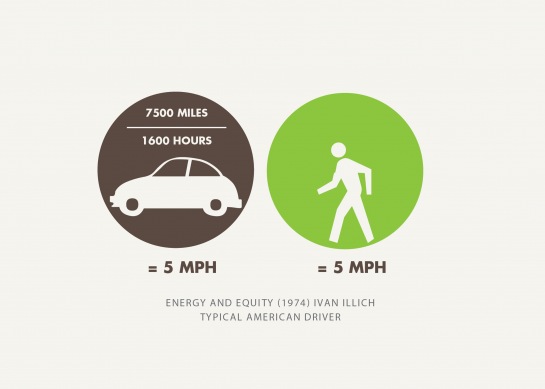
Today we review an article by an Australian, Prof. Tanter, who examines all the extra costs involved in driving cars quickly – and the savings that could be achieved by switching to “slower” models of travel – even though, as he points out, one saves time (and money) by using them.

 Key Quotes:

 “the time we spend at work earning the money to pay for all our transport costs. For pedestrians, this time is virtually nil. For cyclists it is minimal. For car drivers, the time spent earning the money to pay for all the costs of cars is usually much greater than the time spent driving”

 “When we drive faster to save time, the few seconds we save will cost us much more than that in the time needed to pay for the extra fuel, wear and tear on the car, and stress on ourselves”

 “The emphasis in urban areas on increasing the speed and volume of car traffic contributes to ill-health through its impacts on local air pollution, greenhouse gas production, inactivity, obesity and social isolation”

 “the risk of pedestrian death in crashes rises from 5% at 20 mph to 45% at 30 mph and 85% at 40 mph”

“On highways, cars travelling at 60 mph will produce far less CO2 than if travelling at 70 mph (between 10% and 20% less”

 “Slow Cities encourage the use of local materials and foods, reducing the need for transport of goods and materials, particularly by trucks. The emphasis is on making places for people rather than for cars”

“One way to achieve a change in urban transport is to reprioritise whose time is valued in cost-benefit analyses. Improving levels of urban health might be as simple as valuing the time of pedestrians, public transport users and cyclists more than the time of motorists”
Enhanced by Zemanta

Friday, August 3, 2012

What Makes a Sustainable City?

John Whitelegg on “Health in the sustainable city” (Worldstreets:The Politics of Transport in Cities, Jul. 13, 2012)

Also discussed here: Towards a Zero Carbon Vision for UK Transport (68 page pdf, John Whitelegg, Gary Haq,Howard Cambridge and Harry Vallack, Stockholm Environment Institute July 2010)

Today we review a short video from the World Streets blog by Prof. John Whitelegg, an expert in what makes a sustainable city, mainly in terms of transportation. He points out the importance of the choices made in cities to either promote the use of vehicles and roads to carry them or to look for more sustainable, less polluting options such as car free housing, reduced parking spaces etc – all in the face of the challenge of climate change mitigation and the goal to achieve a carbon free city.  

Key Quotes:

 “what experts and professionals call sustainability….would be a city, for example, that has a lot less noise, a lot better air quality, a lot less traffic, a lot more potential for people to stand around and talk and meet their neighbors and not be drowned by noise and disturbance and stink”

 “The challenges tend to be things like how do we actually deal with the development of the city with growing population [and] growing levels of economic activity, things like water shortages and important resource problems that cities are facing.. to actually reduce the amount of resources that we use, metal, concrete, and so on, to reduce carbon dioxide emissions”

 “The things that can be done and should be done are still a bit frightening for politicians, really, but they are about reallocating space, so that space is for people—and not for things that weigh a tonne and are made of metal and kill children when they hit them”

 “A zero carbon road transport system has enormous potential to deliver post-Kyoto GHG reductions and to embed the transport sector firmly within a wider process of societal change that can move beyond rhetoric and target setting and deliver a decarbonised future”
Enhanced by Zemanta

Wednesday, August 1, 2012

Monitoring Pollution below the Clouds from Space

Improving aerosol distributions below clouds by assimilating satellite-retrieved cloud droplet number (Abstract, Pablo E. Saide, Gregory R. Carmichael, Scott N. Spak, Patrick Minnis, and J. Kirk Ayers, Proceedings of the National Academy of Sciences USA (PNAS), Jul. 9, 2012)

 Also discussed here: Researchers Develop Technique to Help Pollution Forecasters See Past Clouds (ScienceDaily, Jul. 10, 2012)

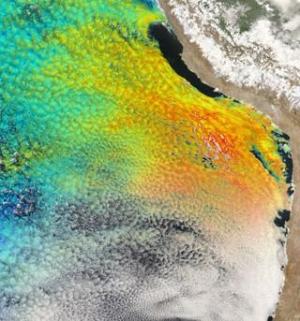
 Today we review research aimed at deducing how much particulate pollution exists below clouds, as observed by satellites which normally have their air quality sensors blocked by the opaqueness of the clouds. The technique is based on comparing the number of droplets observed in a region which does not have particulates with one that does and then accounting for the difference. If applied and found successful, this would overcome one of the main difficulties in monitoring particulates near the ground from space.

 Key Quotes:

 “University of Iowa scientists have created a technique to help satellites "see" through the clouds and better estimate the concentration of pollutants, such as soot”

"Particles in the atmosphere (aerosols) interact with clouds changing their properties. With this technique, we can use remote sensing observations from satellites to estimate these cloud properties in order to correct predictions of particle concentrations. This is possible due to a numerical model that describes these aerosol-clouds interactions,"

 "Unlike previous methods, this technique can directly improve predictions of near-surface, fine-mode aerosols -- such as coal-fired electric generating plants and wood-fueled cooking fires -- responsible for human health impacts and low-cloud radiative forcing (solar heating),"

 "This technique is also complementary to previous methods used, allowing the observing system to 'see aerosols' even under cloudy conditions."
Enhanced by Zemanta